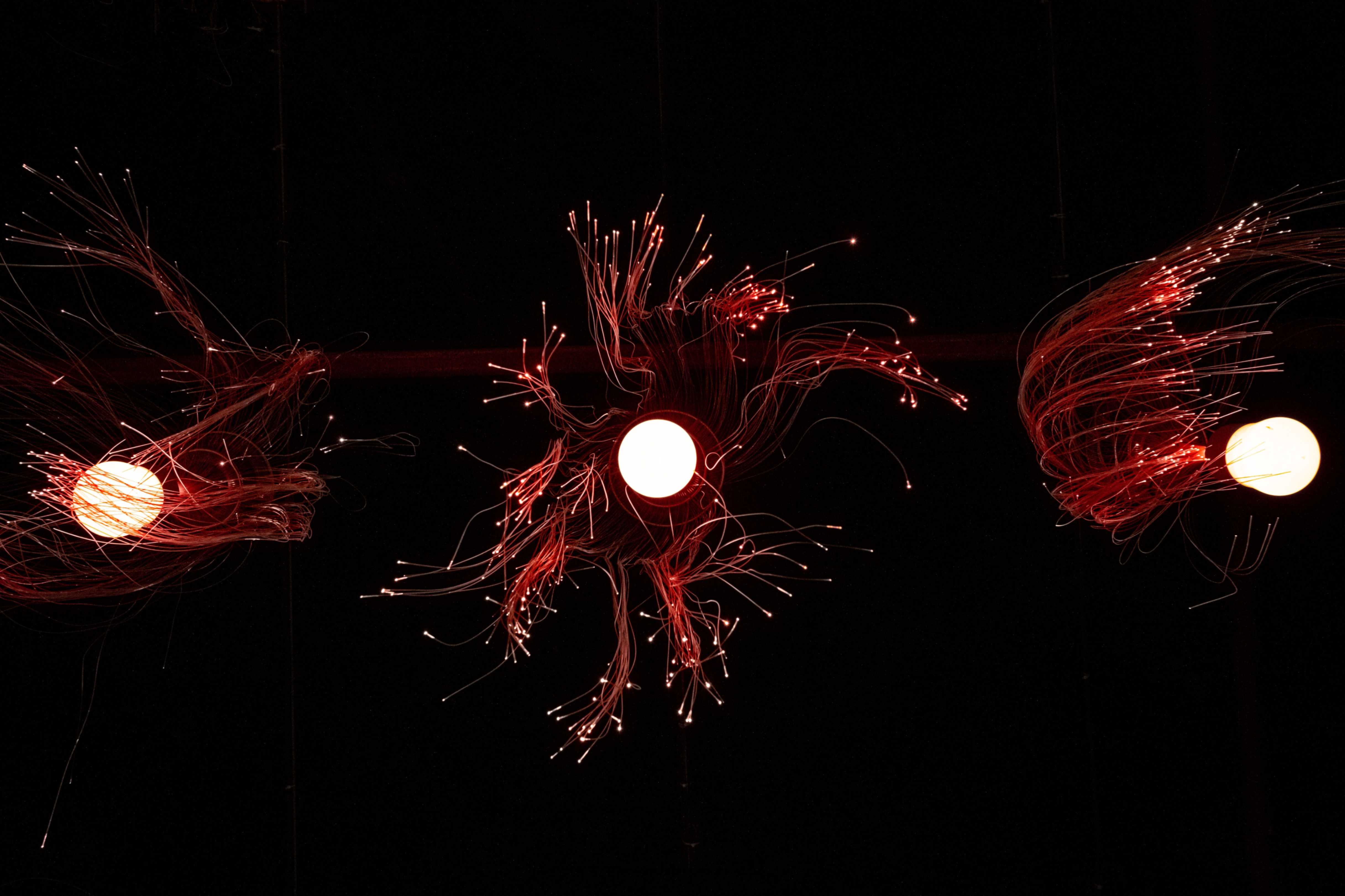
When you open a website hosted on another continent, some of its information may travel through cables lying on the ocean floor. Inside these cables are optical fibres carrying information using light. An optical fibre contains a transparent core surrounded by another material called cladding. The two materials have different refractive indices. Under suitable conditions, light travelling through the core can be guided along the fibre. Total internal reflection can occur when light in a higher-refractive-index material reaches a boundary with a lower-refractive-index material at an angle greater than the critical angle. Modern fibres are designed so that light signals can travel very long distances with relatively low losses. Digital information is encoded onto rapidly changing optical signals. Different wavelengths of light can even carry separate streams of information through the same fibre, allowing enormous quantities of data to be transmitted. Signals gradually weaken as they travel, so long submarine cables contain carefully engineered amplifiers or repeaters. The fibres are also surrounded by protective layers to survive installation, water pressure and hazards on the seabed. Optical fibres are used in local internet networks as well as submarine cables. Related fibre technologies are also used in medicine and scientific instruments. A video can therefore cross an ocean because engineers have learned how to control light inside a strand of transparent material thinner than many people might expect.