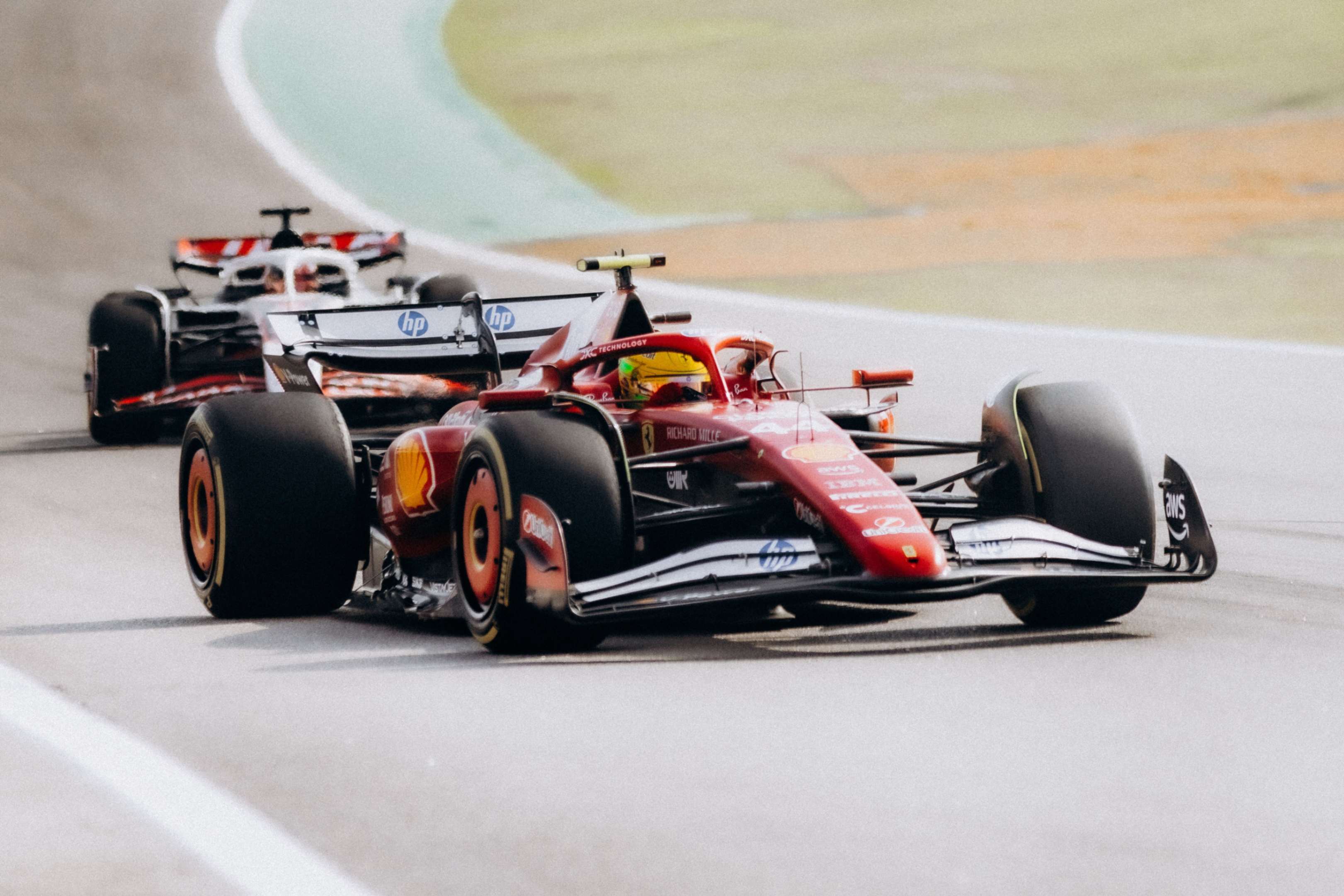
Why does a Formula 1 car have wings, curved bodywork and complicated shapes instead of simply being built like an ordinary car with a more powerful engine? At racing speeds, the car is not only interacting with the road. It is also travelling through a huge amount of air, and that air can produce forces large enough to dramatically affect its performance. As a car travels forwards, it must move air out of its path. Interactions between the car and the surrounding air produce a resistive force called aerodynamic drag. Drag acts in the opposite direction to the car's motion, so the engine must continually transfer energy to overcome it. The shape of the vehicle has a major effect on drag. Pressure differences around the car, airflow separation and friction between moving air and the car's surface all contribute. Engineers carefully shape the bodywork so that they can control how air moves around the vehicle and reduce unnecessary resistance. Speed makes the problem much more important. Under typical racing conditions, aerodynamic drag increases approximately with the square of speed. If the speed doubles, the drag force can become roughly four times as large when other factors remain unchanged. The power required to overcome aerodynamic drag rises even more rapidly with speed. But a racecar is not designed simply to have the smallest possible drag. Engineers also use the airflow to produce downforce. Downforce pushes the car towards the track, increasing the normal force between the tyres and the road. This can allow the tyres to generate larger forces when the car turns, accelerates or brakes. Wings, diffusers and carefully shaped floors can all help produce downforce. However, generating more downforce often increases drag. Engineers therefore have to find a compromise. A car designed for maximum straight-line speed may need different aerodynamic settings from one designed for a circuit containing many fast corners. Engineers investigate these effects using wind tunnels and computer simulations. They can measure aerodynamic forces and study where airflow separates or becomes turbulent before changing the car's shape and testing it again. The same physics matters outside motorsport. Road cars are designed to reduce drag because lower aerodynamic resistance can reduce the energy required to travel at motorway speeds. This can reduce fuel consumption or increase the range of an electric vehicle. So the unusual shape of a racecar is not simply for appearance. At high speed, air becomes one of the most important things the vehicle has to interact with, and controlling that airflow can determine how fast the car can travel and how quickly it can corner.
The same physics applies far beyond motorsport. Road cars, aircraft, bicycles and even high-speed trains are designed with aerodynamics in mind. Reducing unnecessary drag means that less energy is required to move through the air at a particular speed. For an electric car, this can help increase driving range, while for an aircraft it can reduce the energy required during flight. From a racecar travelling around a circuit to a passenger car on a motorway, understanding how air interacts with moving objects allows engineers to make vehicles faster, more stable and more energy efficient.