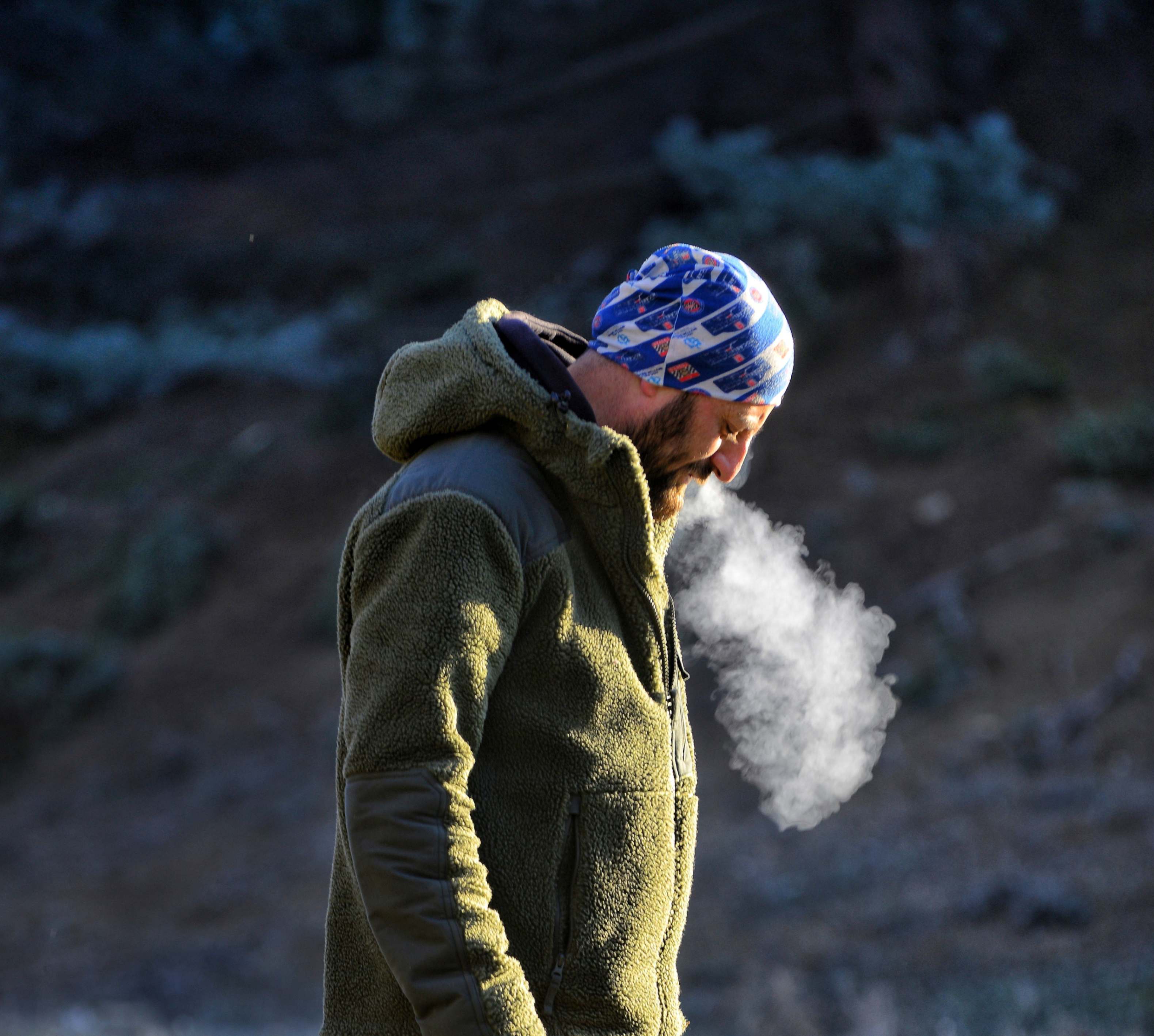
The air you breathe out contains water vapour. On a cold day, that warm moist air mixes with much colder surrounding air and cools rapidly. When the temperature falls enough, some water vapour condenses into tiny liquid droplets. These droplets scatter light and form the small cloud you can see. The water was already present in your breath; the cold air makes it visible by causing a change of state from gas to liquid. It is similar to the mist that forms above a hot drink or on a cold bathroom mirror.
The effect becomes easier to notice when conditions change. Temperature, pressure and particle motion can alter how quickly processes happen or how matter behaves. Food storage, refrigeration, cooking and weather all give everyday ways to test the same particle ideas without needing specialist equipment.
Temperature is linked to the average kinetic energy of particles, while internal energy includes the energy associated with their motion and interactions. Heating transfers energy into a material, but that energy does not always raise its temperature: during a change of state it can instead alter the arrangement and separation of particles. Conduction, convection and radiation then determine how quickly energy moves to or from the surroundings.