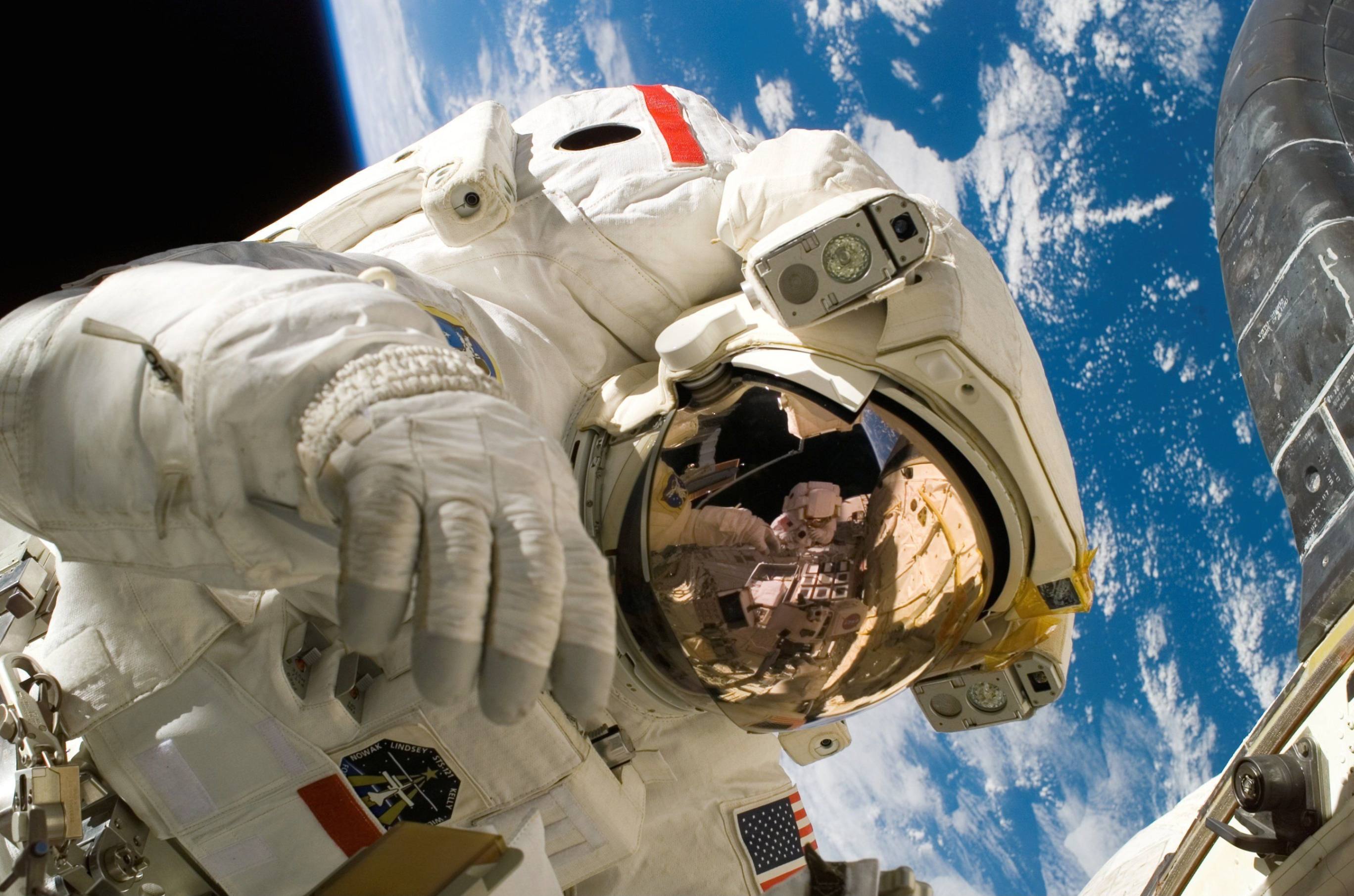
Astronauts on the International Space Station are still strongly affected by Earth's gravity. They float because the station and everything inside it are falling together. The station moves sideways so quickly that as it falls towards Earth, the curved surface of Earth falls away beneath it. This continuous free fall is an orbit. Astronauts, equipment and the station all have nearly the same gravitational acceleration. With little support force between them, objects appear weightless and can drift around. So orbit is not a place where gravity disappears; it is a special kind of falling motion.
Engineers use this relationship when choosing shapes and contact areas. Ships, hydraulic systems, tyres, foundations and cutting tools may look unrelated, but each is designed around how forces are spread through a material or fluid. Similar principles appear in nature too, from broad animal feet on soft ground to floating ice changing the conditions at the surface of a lake.
Gravity is an attractive force between masses. Near a planet, weight is given by W = mg, so mass stays the same while weight changes with gravitational field strength. Orbits are not places where gravity disappears: an orbiting object is continually accelerating towards the body it circles, but its sideways velocity means it keeps falling around it rather than straight into it.