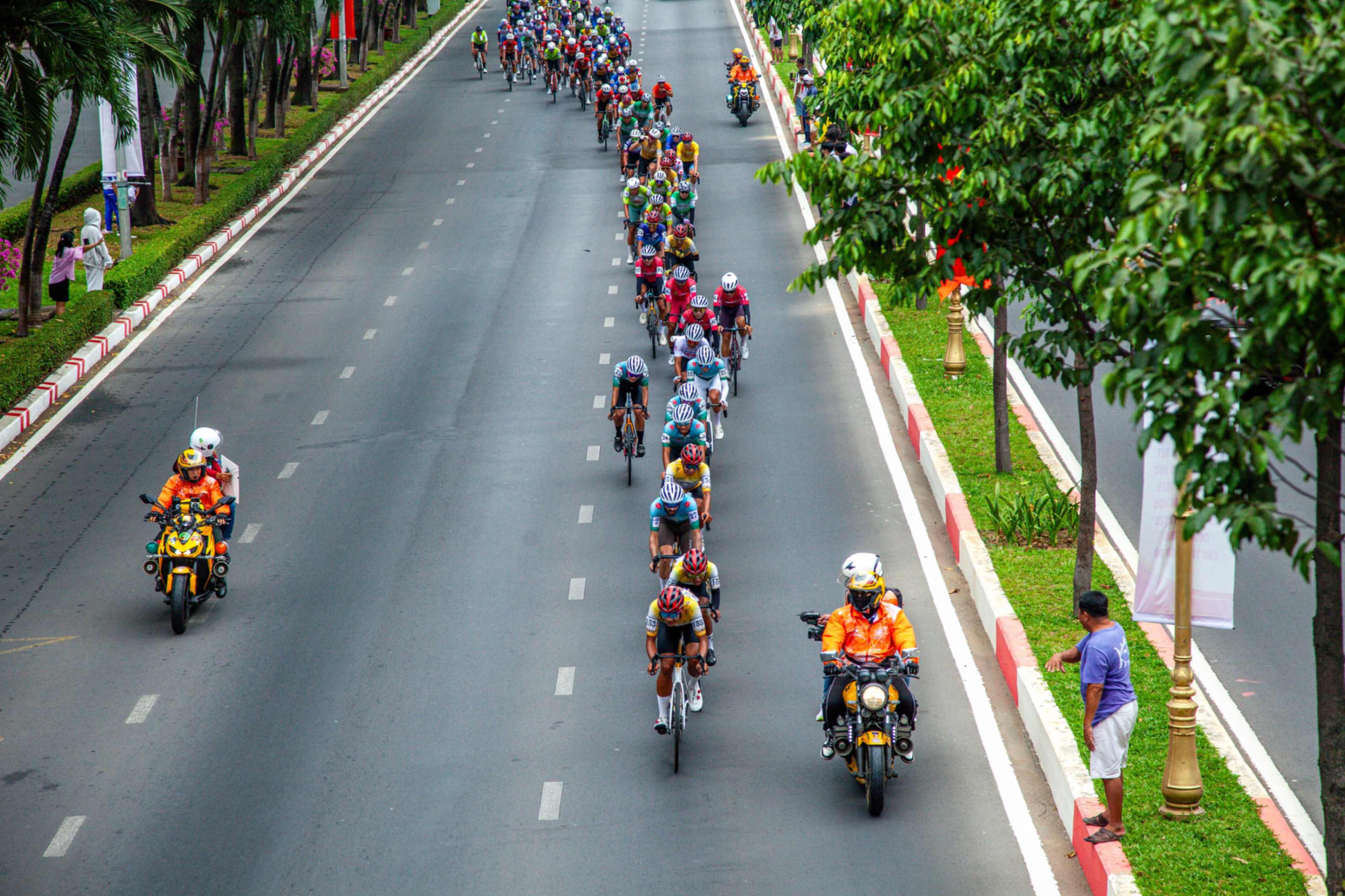
Watch a road race and the cyclists can look almost impossibly close together. The main reason is air resistance. Air may be invisible, but it is made of particles. As a cyclist moves forward, they collide with and push those particles out of the way. The air also pushes back on the cyclist, producing a drag force.
At low speeds that drag is fairly small, but as speed increases it becomes much more important. A rider at the front has to do work to move through the air: a force acts through a distance, transferring energy from the cyclist's chemical energy store. To keep a constant speed, the driving force from the bike must balance the resistive forces. If drag is reduced, less force—and therefore less power—is needed to maintain that speed.
This is where drafting helps. Air approaching the front rider is relatively smooth, but as it passes around the rider and bike it changes speed and direction. Behind them is a wake where the airflow is disturbed and the pressure pattern is different. A following cyclist can sit in this region and experience less drag. The flow around real cyclists is complicated: some regions can be fairly smooth or laminar, while others break into swirling, turbulent flow. Position, crosswinds, wheel shape, clothing and even how a rider holds their arms can change the size and behaviour of the wake.
That is why professional teams form a peloton and take turns at the front. The lead rider does more work against the air while riders behind can save energy for a climb or sprint. Engineers use wind tunnels, smoke streams, pressure sensors and computer fluid simulations to study the airflow around helmets, wheels and frames. Small changes in shape can reduce drag without making the bike unstable in side winds.
Nature uses moving air too. Geese often fly in a V formation. A wing produces rotating air in its wake, including regions of upward-moving air near the wing tips. A following bird can position itself to gain some benefit from that airflow. It is not exactly the same mechanism as cyclists drafting, but both show an important idea: moving through a fluid changes the pressure and motion of that fluid, and objects travelling behind can use those changes to reduce the energy they need.