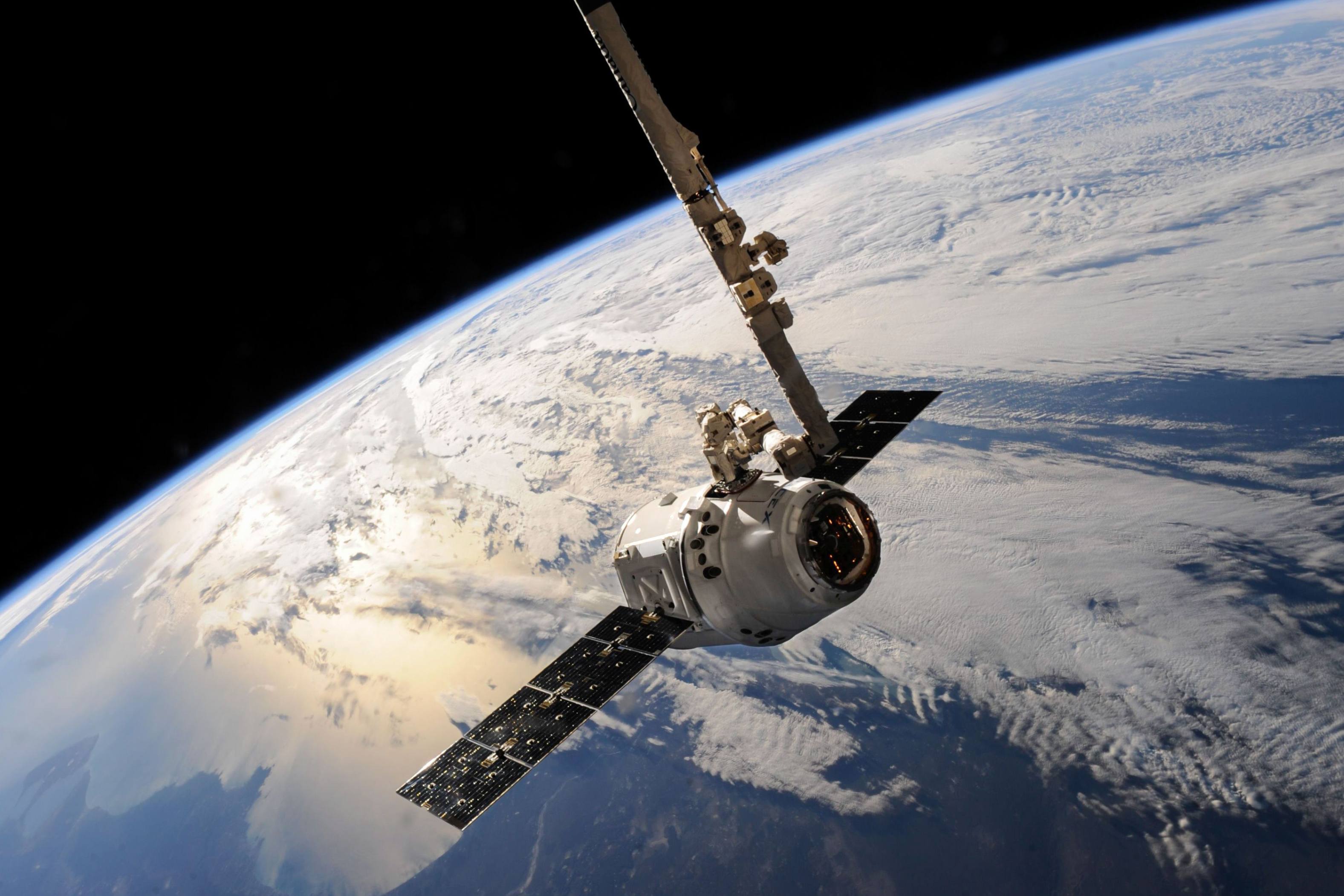
Satellites are constantly falling towards Earth. The reason they do not simply crash is that they also have a large sideways velocity. Gravity changes the direction of the satellite's velocity, producing the acceleration needed for its curved path. As the satellite falls, Earth's surface curves away beneath it. At the correct speed and altitude, this creates an orbit. Too little sideways speed can lead to re-entry; enough additional speed can produce a higher orbit or even escape. An orbit is therefore a balance of motion and gravitational acceleration, not an absence of gravity.
This is also a design problem. Cameras, glasses, screens, road signs and medical scanners all depend on controlling how electromagnetic waves are emitted, absorbed, reflected or refracted. A familiar object can therefore be a practical example of the same wave rules studied in class.
Gravity is an attractive force between masses. Near a planet, weight is given by W = mg, so mass stays the same while weight changes with gravitational field strength. Orbits are not places where gravity disappears: an orbiting object is continually accelerating towards the body it circles, but its sideways velocity means it keeps falling around it rather than straight into it.