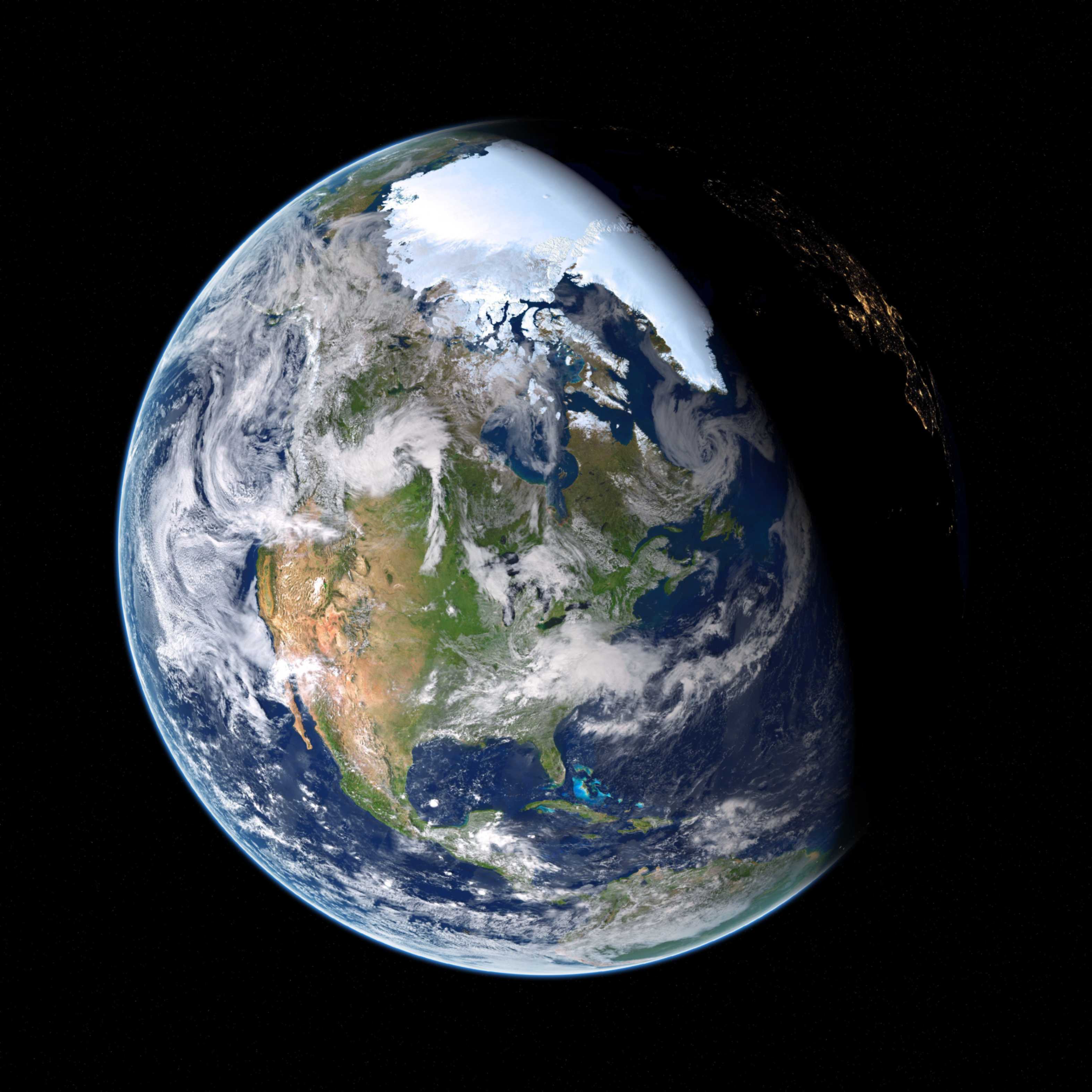
Earth spins and travels around the Sun at enormous speeds, yet sitting in a classroom does not feel like racing through space. The key is not simply that we cannot feel constant velocity: Earth's rotation and its orbit both involve acceleration because the direction of its velocity changes. You, the chair and the air around you share much of Earth's motion. During Earth's orbit, you and the planet are accelerated together by the Sun's gravity, so there is no large, rapidly changing support force for your body to notice. Earth's rotation also produces a small centripetal acceleration, but it is steady and much smaller than many everyday accelerations. A smooth train is still a useful comparison: steady motion can be difficult to detect, while braking, turning and bumps are obvious because they change the forces acting on your body. Motion always needs a reference point, so the answer to 'How fast are you moving?' depends on what you measure your motion relative to.
You can spot the same idea in sport, transport and amusement rides. Designers predict how motion will change before building anything, because forces, momentum and energy affect comfort as well as safety. That is why seat belts, suspension, landing surfaces and ride restraints are physics applications, not just pieces of equipment.
The motion can be understood by adding the forces as vectors. If they balance, the resultant force is zero and the object stays at rest or continues at constant velocity; if they do not, it accelerates. Friction and drag transfer energy to the surroundings, usually as heating, so maintaining a steady speed can still require continuous work even when the speed itself is not changing.